
The Fall-Off Is a Lie. J. Cole Knows It. That's the Whole Point.

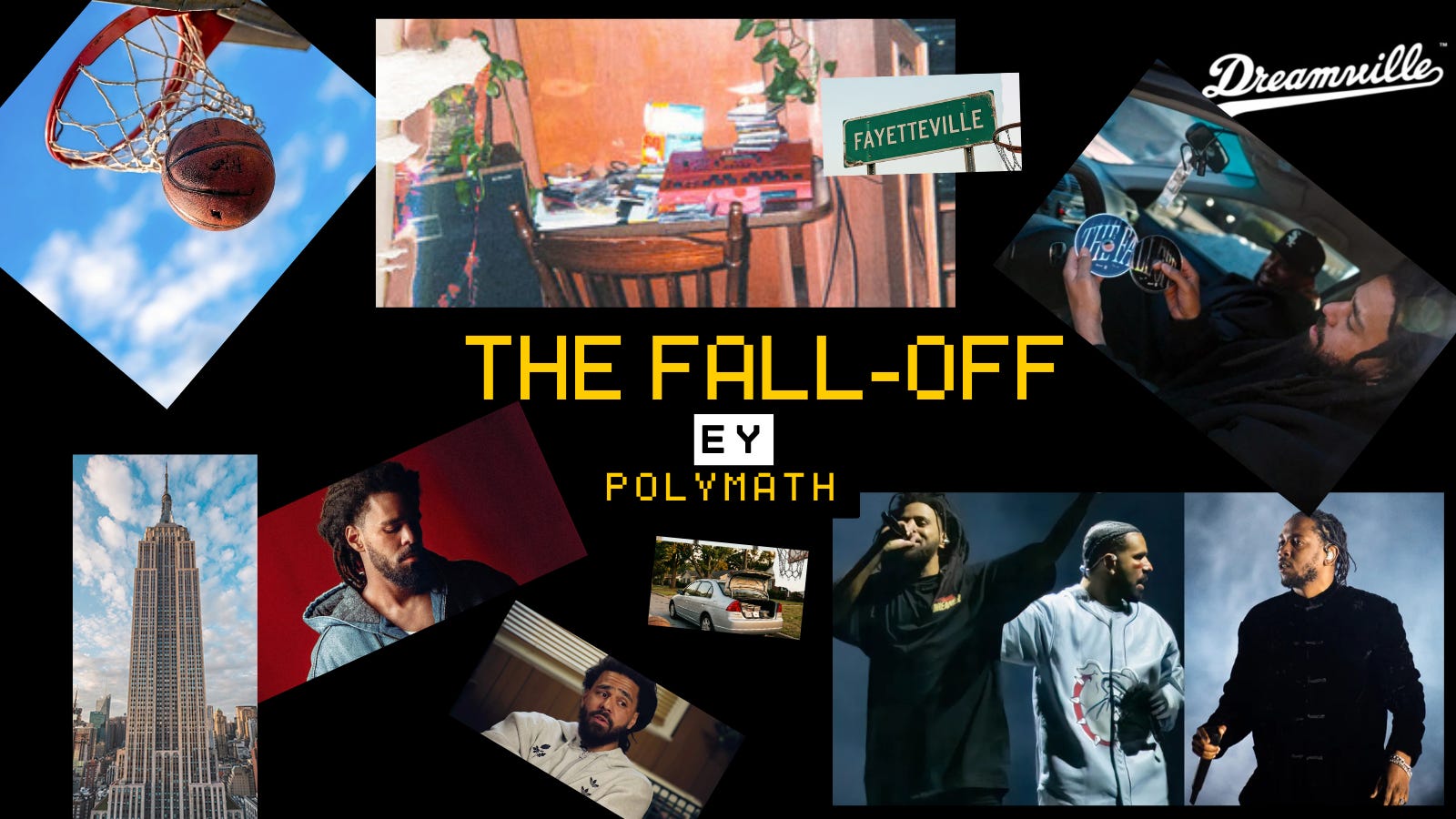
[Tone: Conversational & Analytical]
Look, I had this kid in sixth grade who was always on some bullyish. I called him Mark (because he was a mark ass buster), that wasn’t his real name, but that’s what I called him because he stayed trying to mark his territory in ways that made no damn sense. Mark would start fights in the hallway, but not over stepping on shoes or looking at him the wrong way. Mark would start fights because he talked to people in the most disrespectful manner possible, and thought he could get away with it because his older cousins were actually in a gang.
He’d walk up to you, talking slick, calling you out your name, questioning your resolve (in this case, manhood), running his mouth like consequences were a myth. And when you checked him on it, Mark would start throwing around his cousins’ names like that was supposed to make you back down (it did for most). He thought proximity to their street credibility transferred to him by blood relation, like disrespect was free as long as you had the right last name.
We had to run the fade about four times that year. And I’m 3-1 all-time (he caught me slippin’ once, got the first swing off) with him. Not because I was some feared sixth-grade assassin, but because Mark never learned to adjust his approach. Same energy, same tactics, same result. He’d rush in wild, I’d stay fundamentally sound, and by the end of it, Mark would be on the ground, wondering how he kept ending up there.
I haven’t thought about Mark in probably twenty years, but he came flooding back to me while I was listening to the third verse of “Poor Thang” from J. Cole’s The Fall-Off. You know the one, where Cole eviscerates some unnamed hometown hater with a “punk bitch” scheme so vicious it could’ve been classified as a war crime. The whole verse is Cole calling out someone who’s fronting like Mark used to front, someone pretending to be street when they grew up in the same house he did. “You can’t hide it with tattoos on your physique, punk bitch / And that lingo you added, that how you speak, punk bitch / And you grew up with both your parents to teach, punk bitch / So how the fuck all a sudden you turnin’ G, punk bitch?”
Shoutout to having a third verse, because that’s where Cole lives. That’s where the truth gets told. That’s where you separate the Marks from the people who know what they’re doing.
See, “punk bitch” twenty-one times in about ninety seconds shouldn’t work. It should feel repetitive, juvenile, like somebody’s eighth-grade freestyle cipher. But Cole makes it surgical. Every “punk bitch” is a different angle of attack, a different way of saying you are not who you pretend to be. And listening to it, I realized something: Cole is running the same fundamental game he’s been running for fourteen years, and the culture keeps expecting him to lose because we’ve forgotten how to value the fundamentals.
The Fall-Off is an interesting title for a work of art, especially when the work itself shows the artist hasn’t fallen off. Based on the level of skill exhibited across these twenty-four tracks, Cole ain’t falling off when it comes to writing, finding a pocket on a beat, having a cadence that can captivate you, or just straight-up rapping. So why call it that?
Because the fall-off isn’t what he did, it’s what we do to everybody, eventually.
[Tone: Argumentative & Calm]
J. Cole might be the Tim Duncan of rap, and before you roll your eyes, let me rap.
Tim Duncan was never the guy on the highlight reel. While Kobe was dropping 81 and LeBron was chasing down blocks, Duncan was setting perfect screens and hitting bank shots that looked boring until you realized he’d just dropped 25 and 12 without you noticing. He played for 15 years in the league, won 5 championships, and the most exciting thing about him was that he got a technical foul for laughing on the bench once (classic). The man was so fundamentally sound it was almost offensive to people who wanted their basketball players also to be performance artists.
But here’s the thing about Duncan: when the smoke cleared, and all the highlight reels were compiled, he had more rings than most of the flashy guys. Not because he could jump out of the gym or dunk from the free-throw line, but because he understood that basketball is actually about putting the ball in the basket more times than the other team. Revolutionary concept, apparently.
Hip-hop in 2026 is a league full of players shooting 35-foot heat checks and getting celebrated for the attempt, whether they make it or not. We’ve got artists doing vocal gymnastics that sound impressive for thirty seconds on TikTok but can’t carry a full song. We’ve got rappers who think traveling (Refs, whatever happened to calling that) is a flow pattern instead of something that should get you called for a violation. We’ve got a whole generation convinced that the three-point line is where the game starts, and anything closer to the basket is boring.
Cole is still taking mid-range jumpers and getting called old school for it. He’s the player who shows up to every game in good shape, doesn’t miss practices, knows where everyone else is supposed to be on every play, and quietly puts up 20 and 8 while the crowd is looking for someone to windmill dunk on a fast break. He’s been doing this for fourteen years, seven studio albums, consistent quality, no major scandals, no career-threatening injuries, no dramatic comebacks from the wilderness because he never left.
And the culture has spent that entire time waiting for him to be something he never said he would be.
See, the problem isn’t that Cole fell off. The problem is that we’re judging a power forward by how many logo threes he attempts. We’re mad at him for not being Kendrick’s otherworldly innovation or Drake’s pop-culture domination, but that was never his position. Cole’s position is: show up, do the work, elevate everyone around him, and win games through fundamentals that are harder to highlight but easier to sustain.
[Tone: Playful & Analytical]
If Tim Duncan is who Cole is as a player, the Honda Civic is what he is as a product. And I mean that as the highest possible compliment.
Nobody puts a Honda Civic on a poster. Nobody is saving up for a Civic the way they’re saving up for a Porsche or a Lambo or whatever car is currently being referenced in rap songs to signal that you made it. The Civic doesn’t make you feel anything when you see it pull up. It doesn’t turn heads in the parking lot. It doesn’t have a commercial with a famous athlete in slow motion.
What the Civic does is start every single morning. What the Civic does is get you to 200,000 miles without a major breakdown, while the flashier vehicles are on their third engine replacement. What the Civic does is hold its value in ways that the cars people actually get excited about don’t, because reliability is unglamorous until you’re stranded on the side of the highway. The guy who picks you up is driving a Civic that’s been running since 2009.
Cole is the Civic. Every album starts. None of them break down on you mid-listen. You’re never three tracks in, wondering if he ran out of ideas or phoned it in because a deadline was approaching. He doesn’t have a certified classic, not in the way Illmatic, All Eyez on Me, or My Beautiful Dark Twisted Fantasy are certified classics (he has a classic). Still, he also doesn’t have a disaster in his catalog (maybe). Seven albums deep, and the floor has never fallen out. That’s not an accident. That’s engineering.
The culture wants Lambos. And Cole keeps pulling up in a Civic and winning the long race.
What makes this almost cosmically funny is that when Cole decided to release The Fall-Off, this man literally pulled up in a Honda Civic. The Trunk Sale Tour, February 2026: J. Cole, one of the biggest rappers alive, is selling physical copies of his album out of the trunk of a car like it was a swap meet. Not a stadium. Not a pop-up shop with neon lights and a DJ and a line around the block. A car. A trunk. Some CDs. Get it if you want it.
Most artists would have to do that as a stunt to seem relatable. For Cole, it was the most natural rollout in the world. The metaphor didn’t need to be constructed; it showed up in a Honda Civic and handed him the album.
[Tone: Appreciative & Analytical]
Before we go any further, I need to talk about the basketball bars. Because Cole’s love of the game isn’t decorative; it’s an analytical framework, and The Fall-Off is his most basketball-literate album to date.
On “Run a Train,” Cole paints a portrait of a young man watching drug dealers work a corner and weighing that choice against his own hunger. The verse is heavy, the imagery is specific, and right in the middle of it, he drops this: “Tryna make a legal dollar seem harder than guarding Wemby.” Victor Wembanyama. Seven feet four inches of wingspan and coordination that defies the physics of a human body. Cole using Wemby as the benchmark for impossibility, making legitimate money in a system designed against you, is so precise it makes you stop and rewind it. That’s not a celebrity name-drop. That’s somebody who actually watches basketball using the right reference for the right argument.
But the bar directly before it is what makes the whole stretch sing. “When serving rock on deserted blocks.” Rock. Crack cocaine AND the basketball. Cole sets up that double meaning deliberately, “serving rock” pivots immediately into “if somehow I could ball / I better work hard on my handles, ‘cause niggas gon’ try to rip me.” Drug dealing and streetball occupy the same sentence, the same logic, the same survival calculus. “Rip” is a steal in basketball and a robbery in the streets. Cole doesn’t explain the double meaning because he doesn’t have to. That’s the whole point. You either hear it, or you don’t.
On “Bombs in the Ville,” Cole uses Stephon Marbury’s crossover, one of the most lethal handles in NBA history, the kind that left defenders sitting on the floor looking confused, to describe falling for a woman. “You make a nigga fall like a Marbury cross.” A crossover that drops you is a humiliation in basketball. In romance, it’s a different kind of being swept off your feet. Cole, using Marbury specifically, not just “a crossover,” tells you everything about the level of basketball literacy we’re operating at here.
Then there's "Man Up Above," which contains the most concentrated basketball-reference cluster on the entire album and deploys it for something completely different. Cole describes a shooting, as in gunfire, through the language of the modern NBA: "When niggas stretchin' shit like a new-school power forward / Naz Reid range." Naz Reid is a Timberwolves big man who shoots threes at a volume and distance that would've been unthinkable for his position fifteen years ago. "Stretching shit" is what modern bigs do when they step behind the arc. Cole uses the evolution of the power forward position to describe how far a shooter's range extends, then flips it. He's not talking about basketball anymore. And you feel the pivot in your chest.
Then: “Put seven on his torso and turned him into Melo.” Carmelo Anthony wore #7. Seven bullets, seven becoming a jersey number, a body becoming a statistic wearing Melo’s number. Then the closing shot, “But no midrange iso, back to the basket.” Carmelo’s whole game was the midrange isolation, back to the basket, post-up, turn, and fire. Cole is saying this body isn’t doing any of that. It’s just back to the basket. Still.
And then, after all of that, there’s “Only You,” where Cole drops this completely deadpan: “Dropped a triple-double last week at Lifetime Fitness.” Triple-double at Lifetime Fitness. Not the Barclays Center. Not the Garden. Lifetime Fitness, the suburban gym chain where 39-year-old men play pickup with other 39-year-old men on Tuesday evenings. Cole is a multimillionaire who could buy an arena, and he’s out here tracking stats at the gym chain his accountant probably also uses. That line is one of the funniest on the album precisely because it’s delivered without a single wink.
This is what separates Cole from rappers who drop a LeBron reference to sound current. Cole knows the game. He knows the positions, the players, the history, and the evolution of the game. When he reaches for basketball, it lands because it’s coming from someone who actually loves it, and because he understands that the game, like rap, rewards people who learn its fundamentals deeply enough to play them with style.
[Tone: Analytical & Deliberate]
To understand The Fall-Off, you need to understand what happened before it. And to understand what happened before it, you need a framework. So here’s one: The Trident Break.
For years, hip-hop operated under what felt like a gentleman’s agreement. Drake, Kendrick Lamar, and J. Cole were the “Big Three,” acknowledged by the culture, and most famously, acknowledged on wax. In October 2023, “First Person Shooter” featured Drake and Cole co-signing the trident out loud, the two of them declaring themselves and Kendrick as the top three in the game, with all the ceremony of a public peace treaty. The culture accepted it.
Then Future and Metro Boomin’ dropped “Like That” in March 2024 and blew the assumed treaty up on a Metro Boomin beat.
What followed was the most significant beef in rap history: Kendrick and Drake trading shots over weeks, the whole culture taking sides, the stakes escalating beyond music into personal history and cultural reckoning. And right in the middle of it, Cole dropped “7 Minute Drill,” his entry into the war. He was in it. He chose a side.
Then, almost immediately, he unchose it.
Cole pulled “7 Minute Drill” back, issued a public apology (one of the more unique moments in Hip-Hop culture), and stepped out of the conflict entirely. What remained was a two-country war, Drake versus Kendrick, while Cole became something like a neutral state. The Trident was broken, and Cole was left on the outside of the defining rap moment of his era, the one he’d briefly stepped into and then walked back out of.
The Fall-Off was rerecorded in the shadow of all of that. And you can hear it everywhere if you know where to listen.
Cole originally had Kendrick featured on this album. He confirmed it himself in an interview on Cam’ron’s show; there were two Kendrick features on the original version of The Fall-Off before “7 Minute Drill” blew everything up. Those features are gone now. What’s left is an album haunted by the ghost of a version that no longer exists, collaborations between men who were supposed to still be on the same side.
“Lonely at the Top” is the most direct address of what The Trident Break cost Cole emotionally. The verse describes him watching the older kids run up the slides and hang upside down from the monkey bars while he stood at a distance, waiting for his turn. And then: “Mama done let me come outside, but now them slides are vacant / The big boys done skated.” Cole finally made it to the level of his heroes and peers, and by the time he got there, the playground was empty. The timing was off. The longing in that song isn’t abstract; it’s Cole describing a specific reality, a specific era where the people he wanted to compete with and be elevated by are no longer operating on the same frequency, for different reasons.
Then there’s “What If.” And this is where Cole does something that only makes full sense once you understand The Trident Break.
The song has two verses. Verse one is written from Biggie’s perspective, Biggie reaching out to Pac in the middle of the East Coast/West Coast war, hearing “Hit Em Up,” and choosing to write a letter instead of escalating. “I love you / I hope it ain’t too late to tell you.” Biggie visiting Pac in the hospital after he got shot. Biggie apologizing for not writing while Pac was locked up. Biggie choosing the bigger man position when everyone around him was telling him to go to war.
Verse two is Pac’s response. He received Biggie’s letter on the day he was going to Vegas. “Today, was goin’ to Vegas until I opened your letter / I cried through all of these pages, been tryin’ to get it together.” In Cole’s version, Pac chooses peace. He acknowledges his ego got involved, that the war went further than it needed to. He apologizes. The two greatest rappers who ever died in a beef reconcile in a song written by someone who just had to publicly walk back his own entry into a beef.
Cole is not subtle about what he’s doing. He’s processing the Trident Break through the ancestors, using the most famous unresolved rap conflict in history to imagine what choosing differently looks like. What if the bullshit never got in the way? What if both sides had written the letter instead of loading the gun? The song isn’t nostalgia. It’s statecraft. It’s Cole, as a neutral state, modeling the diplomacy he wishes had been available in April 2024.
The Trident Break didn’t break Cole as an artist. But it did change this album, and it shadows every song on it where Cole is talking about isolation, about missing his peers, about the cost of getting to the top of a game where the people you wanted to share it with are no longer available to share it with you.
You can hear it. You just have to stay long enough to listen.
[Tone: Critical & Fair]
Here’s the thing about J. Cole that makes him genuinely interesting as an artist and genuinely frustrating as a human being: he is capable of extraordinary emotional intelligence and jaw-dropping ignorance sometimes within the same breath. Not as a performance. Not as a character. As himself. And the album asks you to hold both of those things at the same time, which is either Cole’s greatest artistic strength or his most honest admission, depending on which verse you’re on.
Start with “Life Sentence.” Four verses tracing the full arc of a relationship, the early longing, the uncertainty, the temptation of fame pulling him sideways, and the choice to commit. Cole walks through the entire emotional life of a marriage with the kind of specificity that most rappers wouldn’t touch, including the uncomfortable parts. Verse four is Cole admitting he was drifting, that the women who ignored him before his career were suddenly available, that the devil was on his shoulder telling him to quit her, and he was listening more than he should have been. “I’m doin’ dirt, but it’s not as much as I could be / That make me feel better.” That is not a flattering line. Cole is not painting himself as the perfect husband. He’s painting himself as a man who made the right choice after seriously entertaining the wrong one. That’s real. That’s rare. That’s the kind of vulnerability that makes you trust a writer.
This isn’t new territory for Cole either. On “Sacrifices” from Revenge of the Dreamers III back in 2019, Cole used his verse to announce, on wax, before a press release, to the culture, that his wife was pregnant with their second child. Not as a flex. As a tender acknowledgment that the sacrifices they’d both made were worth it. A rapper announcing a pregnancy in his verse, the way a man writes in a diary is not nothing. In a genre where marriage is either a punchline or a status symbol, Cole treats it as a sacred institution worth documenting honestly.
Then SAFETY happens. And we need to talk about it.
The song is structured as three letters written by three different Fayetteville homeboys to Cole. Three voices, three updates from home, three windows into the world Cole came from. The first two verses are beautiful, warm, specific, the kind of detail that makes a place feel real. Then the third verse arrives: a narrator named Quay has died, and the narrator is processing the loss and the guilt over how their friend group treated Quay when he came out.
And this is where Cole writes something he did not have to write the way he wrote it. The narrator describes Quay going to A&T, and I’m quoting directly here, “Runnin’ with fruity types, dick in the booty types / Tight pants, switchin’ their hips, paintin’ their nails / So niggas from the ‘Ville had to distance ourselves.” That language is unnecessary. The homophobia in those lines isn’t serving the story; it’s decorating it. Cole has enough craft to convey the group’s ignorance without the narrator enthusiastically embodying it in graphic detail. (I legit don’t want to be the language police, yet I think there’s power one holds when addressing people who are under constant threat)
Now here’s what you need to know, because the full picture is more complicated than a drive-by reading allows: the same verse ends with the narrator catching himself mid-slur, literally stopping before he finishes the word, and landing here: “Now that we grown, I wish I could apologize, ‘cause we did him wrong.” Cole writes the narrator’s regret into the same verse as the narrator’s ignorance. He’s not endorsing the homophobia. He’s depicting a man who participated in it and eventually came to understand it was wrong.
That is a more sophisticated literary move than it gets credit for. Cole is writing the full emotional arc, the ugliness, AND the accountability, inside six minutes of audio. That’s the intelligent part.
But here’s where “smart-ignorant” as a framework earns its name. The intelligent choice to write Quay’s story through a narrator who grows doesn’t require the narrator to use that specific language to establish his previous ignorance. The narrator could have been depicted as someone who participated in the homophobia without Cole writing the most graphic version of it. The craft and the carelessness exist in the same verse, and you genuinely cannot separate them. Cole is smart enough to write the redemption arc. He is also somehow not scrutinizing the lines that get you to the redemption closely enough.
This contradiction is not new. Cole has always contained the smart-ignorant split. It’s what makes him compelling and maddening. The man who writes “Life Sentence” with that kind of marital honesty and the man who writes “fruity types, dick in the booty types” without blinking are the same person, operating in the same album, sometimes in the same song. The Tim Duncan of rap is still a product of Fayetteville, North Carolina, in the nineties, and some of what he absorbed there shows up in the work unexamined.
The culture tends to do one of two things with this contradiction: pretend it doesn’t exist because the vulnerability is too good to complicate, or weaponize it to dismiss everything else. Neither of those is honest. What’s honest is that Cole’s greatest strength as a writer, his willingness to document real human behavior without cleaning it up, is the same quality that produces the SAFETY verse’s graphic language. He’s documenting. He doesn’t always carefully audit what he documents.
That’s the contradiction. That’s Cole. You don’t have to resolve it. You just have to see it.
[Tone: Observational & Sharp]
At some point in the last decade, the album stopped being the unit of measurement in hip-hop. The song became the unit. Then the hook became the unit. Then the first seven seconds of the hook became the unit, because that’s what the algorithm needs to decide whether it’s going to show your content to the next person or let it die in the feed.
Cole made a double album.
Twenty-four tracks. A hundred and one minutes. Two discs with distinct emotional architectures, Disc 29 as a 29-year-old man returning home to Fayetteville at a crossroads, Disc 39 as a 39-year-old husband and father making the same trip with a different set of questions. There is no obvious single. There is no three-minute TikTok bait. There is no feature chosen to generate a trending moment. This album is not built for the feed. It is built to be lived in.
The features Cole chose tell you everything about the sensibility behind the record. The Alchemist produced “Bunce Road Blues,” the same Alchemist who has spent twenty years being the producer of choice for rappers who care more about craft than commerce. Future shows up on that same track and on “Run a Train,” which is a pairing that sounds unlikely until you hear it, and then it makes complete sense because Future, at his best, is also someone who understands how to disappear into a pocket and let the music do what it needs to do. Tems closes out “Bunce Road Blues” with an outro that opens up into something cosmic, her voice doing things over an Alchemist beat that reminds you why some collaborations exist outside of any algorithm’s logic. These are not features chosen to cross demographics. These are features chosen because they were the right people for the right songs.
The rollout matched the record. Cole went silent for a month before the interviews started. No teaser singles dropped to warm up the streaming numbers. No countdown content. No “the album is almost here, stay tuned” posts every three days. Just silence, then a teaser video in January 2026, then the tracklist, then the album. And then, the day after the album dropped, the Trunk Sale Tour: Cole loaded physical CDs into the trunk of his old Civic with a brand new engine and pulled up to random spots to sell them to whoever showed up. Not a pop-up shop. Not a VIP experience. A trunk. A car. Come get it if you want it.
Cole wrote on social media that, as a teenager, he used to stand outside gas stations trying to sell strangers copies of a local Fayetteville rapper’s album, opening with “yo, you like hip-hop?” That was his first experience with music as a transaction between an artist and a listener, no intermediary required. The Trunk Sale Tour was Cole trying to feel that again at 41, which is either the most romantic thing a famous rapper has ever done or the most stubborn thing, and the answer is probably both.
The anti-algorithmic argument isn’t that streaming is bad or that short-form content is the death of music. The argument is simpler: Cole made the record that needed to be made, in the length it needed, with the people who belonged on it, and released it in the way that felt most honest to what the project actually was. In a landscape where every decision gets filtered through what will perform, Cole made a series of decisions about what was true. Those are different filters. Most people in his position stopped using the second one a long time ago.
[Tone: Definitive]
There is a track on Disc 39 called “The Fall-Off Is Inevitable.” It is not a resignation. It is not Cole waving a white flag or apologizing for something. It is a statement of fact delivered without flinching: everything falls off eventually. Every era ends. Every version of yourself that the culture decides it’s comfortable with gets replaced by a new version the culture hasn’t yet decided how to feel about. The fall-off is not optional. It is the destination.
Cole named his album after this. He named it after the thing every artist fears and the thing every culture eventually does to its artists, and then he made twenty-four tracks that argue he hasn’t done it yet.
Here’s what the reviews got wrong. The question was never “is this a classic?” The question was never “does this go hard enough,” or “did he respond to ____ correctly,” or “does this chart.” Those are the league’s questions. Those are the metrics of a game that has decided logo threes and ankle-breakers are the whole point. Those are the questions you ask when you’ve forgotten that Tim Duncan won five championships, being called boring.
The right question is: did J. Cole make the record he set out to make, with the skill, honesty, and intention the record required? And on twenty-four tracks, across a hundred and one minutes, covering everything from a sixth-grade Mark fronting gang credibility he didn’t earn to Biggie writing Pac a letter in 1996 to a triple-double at Lifetime Fitness on a Tuesday afternoon, the answer is yes. Unambiguously, documentably, technically undeniably yes.
He is still the Tim Duncan of rap. He is still the Honda Civic of hip-hop. He is still the guy who gives you the third verse when everyone else stopped at the hook, the guy who documents his marriage with the kind of honesty that makes you uncomfortable because you recognize it, the guy who gets on an Alchemist beat with Future and Tems and makes it feel like the most natural thing in the world, the guy who loads CDs into the trunk of an old Civic to sell to strangers because that’s how it felt when music was still something you held in your hands.
The Fall-Off is not what he did. The fall-off is what the culture eventually does to everybody. Cole looked that truth dead in the eye, named his album after it, and then made the strongest argument he’s ever made for why it hasn’t happened to him yet.
Most will find this album good. Some will find it great. A few will sit with it long enough to understand what Cole was actually doing, and those people will find something else entirely, a man at the peak of his craft, refusing to play a game that stopped valuing his position, betting on fundamentals in a league full of heat checks.
The bank shot still counts for two. I recommend you give the album a listen.
SWIRV. 🖖🏽